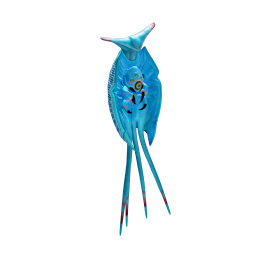
Cerathecan
"Our PDAs point to organisms like the cerathecan and exclaim 'behold: the road not taken'. On Earth, seed shrimp are tiny slime-dwellers; on Proteus they grow huge. But just as easy life in our decontaminated bases deafens us to the call of Proteus, easy analogies blind us to the truth. The map from Earth is not only wrong, so is its basic dogma. Evolution does not follow roads here." —Anita Gottschall, *The Way Away Home*
Profile: Carnivore · Large
Stats
Behaviour
Profile: Carnivore · Large Targets: Small creature
Habitat Distribution
Total spawn points: 20
PDA Databank
"Our PDAs point to organisms like the cerathecan and exclaim 'behold: the road not taken'. On Earth, seed shrimp are tiny slime-dwellers; on Proteus they grow huge. But just as easy life in our decontaminated bases deafens us to the call of Proteus, easy analogies blind us to the truth. The map from Earth is not only wrong, so is its basic dogma. Evolution does not follow roads here." —Anita Gottschall, *The Way Away Home*
*Exile cerathecan*, the horn-cupped exile. A mysterious carnivore and deposit feeder with no clear Earth analog except the tiny ostracod (seed shrimp).
1. Exile
A crustacean hidden in an upright, double-valved shell, similar to an oyster or clam. The crustacean pilots the shell through a central eye and periscopic ears, and feeds with a cluster of basal tentacles. A thruster in the shell's hinge (a region called the umbo) propels it forward.
2. Behavior and diet
The cerathecan grazes on the seafloor, plucking detritus and prey from hiding places. To protect the cerathecan's body from struggling prey, the interior of the shell is lined with a paralytic neurotoxin. The cerathecan's shell muscles are themselves paralyzed by this toxin — it cannot open without secreting an antidote.
3. Perplexing genetics
There are no genes in the cerathecan's genome to produce a shell. Genetically, the cerathecan is simply a large shrimp. The shell tissues contain a partial genome, without organs to sustain an independent life. Further investigation required.
Assessment: cryptic origins. The inner shell can be sampled for chemistry when it opens to feed.