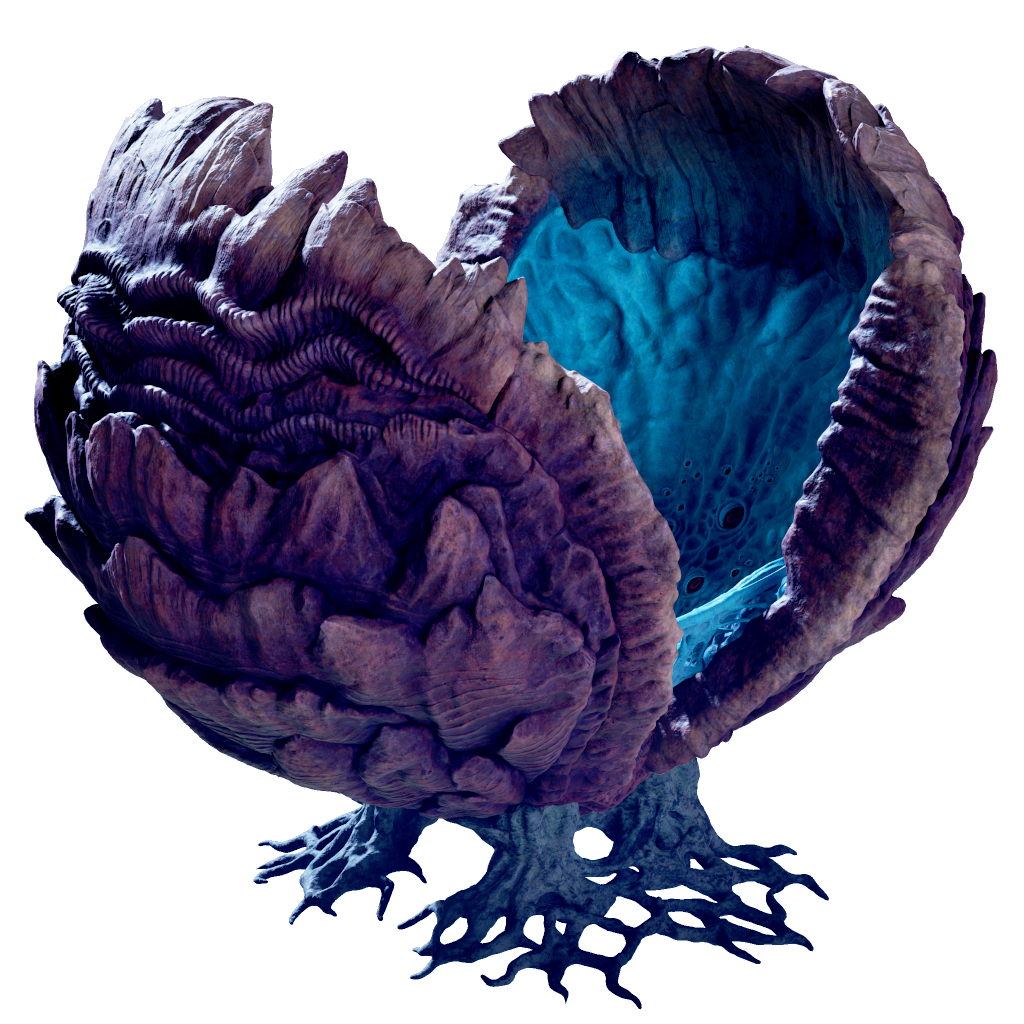
Great Jaw
Great jaw (tentatively *Megamya sudacna*, great clam that bites you). An enormous omnivorous clam with a a dangerous defensive/feeding strategy.
PDA Databank
Great jaw (tentatively *Megamya sudacna*, great clam that bites you). An enormous omnivorous clam with a a dangerous defensive/feeding strategy.
1. Clam
Like Earthly bivalves, the great jaw's body consists of two minerals shells connected by powerful adductor muscles. The clam's main body, including its digestive organs, heart, and gills, rests inside the shells.
2. Mantle
The mantle (the same body part that forms the outer skin of a squid) secretes a matrix of bioplastics on which the hard calcium carbonate shell grows. The enormous size of the adult great jaw's shell may take decades or centuries to achieve. The interior of the mantle is lined with motion-sensitive eyes.
3. Closure reflex
When the tendons of the adductor muscles are disturbed, the shells close, trapping prey inside. The jaw then secrets domoic acid neurotoxin. Projected symptoms: nerve damage, short term memory loss, death.
4. Mixed feeding strategy
The great jaw's interior is lined with tiny coral polyps, which feed on sunlight with photosynthetic bacteria. The majority of the great jaw's food probably comes from photosynthesis.
5. Lithium pearls
The great jaw bioaccumulates lithium during its growth. Nodules are expelled by the clam's body to prevent nerve interference. Recommend retrieval.
6. Youth
The scanned index specimen is relatively young. No upper size limit can be established.
Assessment: critical source of lithium, but dangerous to dive. Avoid touching tendons. Ensure you have an up to date body scan.